About
About
I’m a food safety consultant specializing in produce safety for controlled environment agriculture. My approach is practical and systems-based: I look at how your operation actually works — its water, layout, inputs, and people — and build food safety from there, not from a template.
NECAFS and UVM Extension
From 2021 to 2025, I worked at the Northeast Center to Advance Food Safety (NECAFS) at UVM Extension, supporting FSMA Produce Safety Rule education and technical assistance for small and mid-sized producers across the US.
While I was there, I built NECAFS’s produce safety resources for hydroponic and aquaponic operations: a hub guide, grower factsheets, on-farm case studies, webinars, a glossary, and CEA supplements to the PSA Grower Training. The materials are public at go.uvm.edu/ponics — so you can see the work before you decide to hire me.
Research background
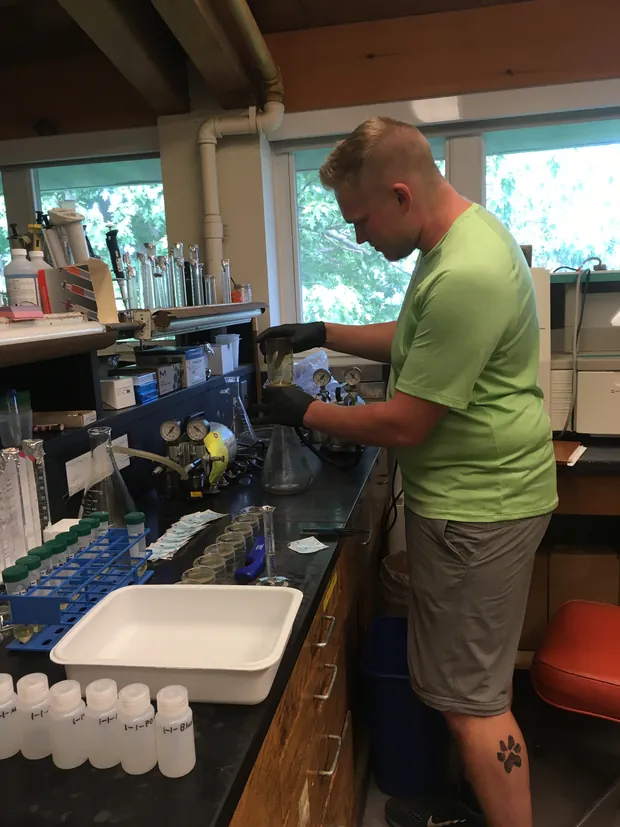
My master’s research was an investigation of microbial water quality in greenhouse-scale aquaponic systems — not lab-scale, the real thing. Recirculating water is the hazard that most distinguishes CEA from outdoor produce, and it’s the area I’ve studied most directly.
At NECAFS, alongside the hydroponic and aquaponic resource work, I helped coordinate the Northeast Produce Safety Research Consortium — a group of research teams across the region working on shared produce safety questions. Day to day, that meant running its meeting cycle every three weeks, keeping its records, and, before each growing season, reconciling methods across the groups so that results from different labs would be comparable. Making sure a measurement means the same thing wherever it was taken is its own kind of food safety work — and it shapes how I read an operation’s records and data.
Teaching and communication
I teach in the Life and Physical Sciences Department at Great Bay Community College. Between classroom teaching and grower education, much of my work has been translation — like taking a technical food safety requirement and explaining it in terms an operations team can use. A readiness assessment is only useful if the people who read it understand it.
Credentials
- PSA-certified Trainer
- UF/IFAS Packinghouse HACCP certification
- M.S., Agricultural Sciences
- B.S., Sustainable Agriculture & Food Systems
How I work
Every recommendation I make is specific to your operation. I don’t write template food safety plans — a plan that controls hazards has to reflect your own water sources, layout, equipment, and staff workflows, and a template doesn’t.
I may use software tools to organize notes and improve workflow, but food safety judgment stays with me. Site observations, hazard analysis, recommendations, and final reports are my responsibility — you’ll never get a chatbot-written report.
A few things I don’t do:
- I don’t run the audit. That’s the certification body’s job, and a consultant who both prepares and audits is a conflict of interest. I get you ready; an independent auditor evaluates you.
- I don’t do compliance theater. Paperwork matters, but it can’t substitute for a system that actually controls hazards.
- I don’t work outside CEA. Traditional outdoor produce has plenty of good generalist consultants. My value is the systems-level questions — recirculating water, indoor production hazards — and that’s where I’m most at home.
Talk through your setup
If you want to think through where your operation stands, I’m glad to talk. A free 20-minute call is a good place to start — tell me who your buyers are, what they’re asking for, and where things stand now.